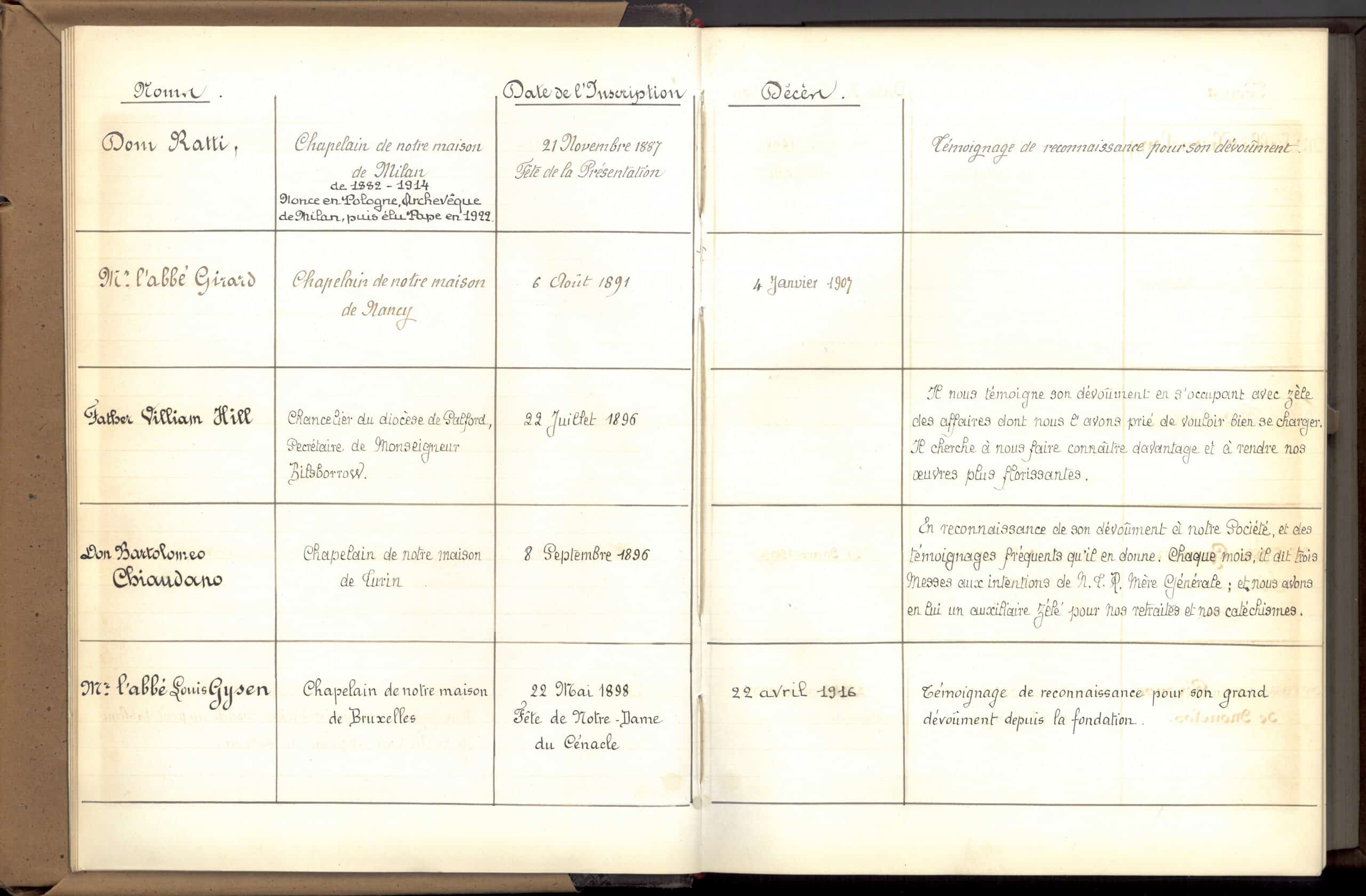
Pages 35–36 of the general catalog of the first- and second-degree Aggregates of Our Lady of the Cenacle (Aggregates in Paris).
Source: MM, 1N 6
The third degree of the Aggregation brought together spiritual and material benefactors. Their connection with the Congregation took the form of a “simple union of prayers” and entitled them to “privileged participation in the merits” of the Congregation. They did not make a formal commitment of consecration, nor did they take steps to join the Aggregation, although some priests were listed after expressing a “desire to have a connection with the Cenacle.”
Beyond the women who joined the Aggregation, the Cenacle thus maintained special ties with people who contributed to its mission through their spiritual and/or material support. The general register bears witness to this recognition by listing these benefactors, who were granted a particular form of spiritual participation in the Cenacle charism.
Two categories are distinguished: spiritual benefactors, including diocesan priests and religious priests who showed great dedication to the Congregation, and temporal benefactors, whose financial assistance or services have contributed to its development. The entries date from 1882 to 1937 for the former and from 1883 to 1937 for the latter. They reflect the diversity of the support received by the Cenacle all around the world.
Among the spiritual benefactors are several chaplains of Cenacle houses, including those in Italy, France, and Belgium, as shown here. The register also mentions priests whose ties to the Congregation were both spiritual and familial. For example, Abbé de Ligonnès, superior of the major seminary in Mende and brother of Mother Hélène de Ligonnès, was listed in 1884. He provided significant assistance with the founding of the house in Rome. Abbé Chesnelong, in Paris, also appears among these benefactors, with the note “in charge of the Aggregation.”
The temporal benefactors, meanwhile, contributed in particular to the establishment and development of the communities. In 1883, Enrico Formichi was listed for his involvement in the purchase of the house in Rome, known as the Stamperia, and for overseeing the construction work. In 1932, Count Candido Mendes de Almeida was recognized for the assistance he provided during the early years of the Cenacle in Rio de Janeiro.
Other entries highlight more personal or professional services. In 1892, Dr. Eugène Vincent, physician to the Lyon community, was honored “in recognition of his dedication and the care given to Mother Cécile de Fraix.” Legal professionals also appear in the register: Maître Auguste Rivet, who defended the Congregation in legal disputes concerning ownership of certain houses following the anticlerical measures of the early twentieth century, and Maître Edward Mac Guire, a lawyer in New York, recognized for the “outstanding services rendered (free of charge) to our house in New York.”
These few names reveal the breadth of the network of support surrounding the Cenacle Sisters. Priests, physicians, lawyers, and benefactors all contribute, according to their means and expertise, to the life and outreach of the Congregation. Their inclusion in the register reflects the Cenacle’s desire to acknowledge these relationships and offer those who support its mission a privileged form of participation in its spiritual life.