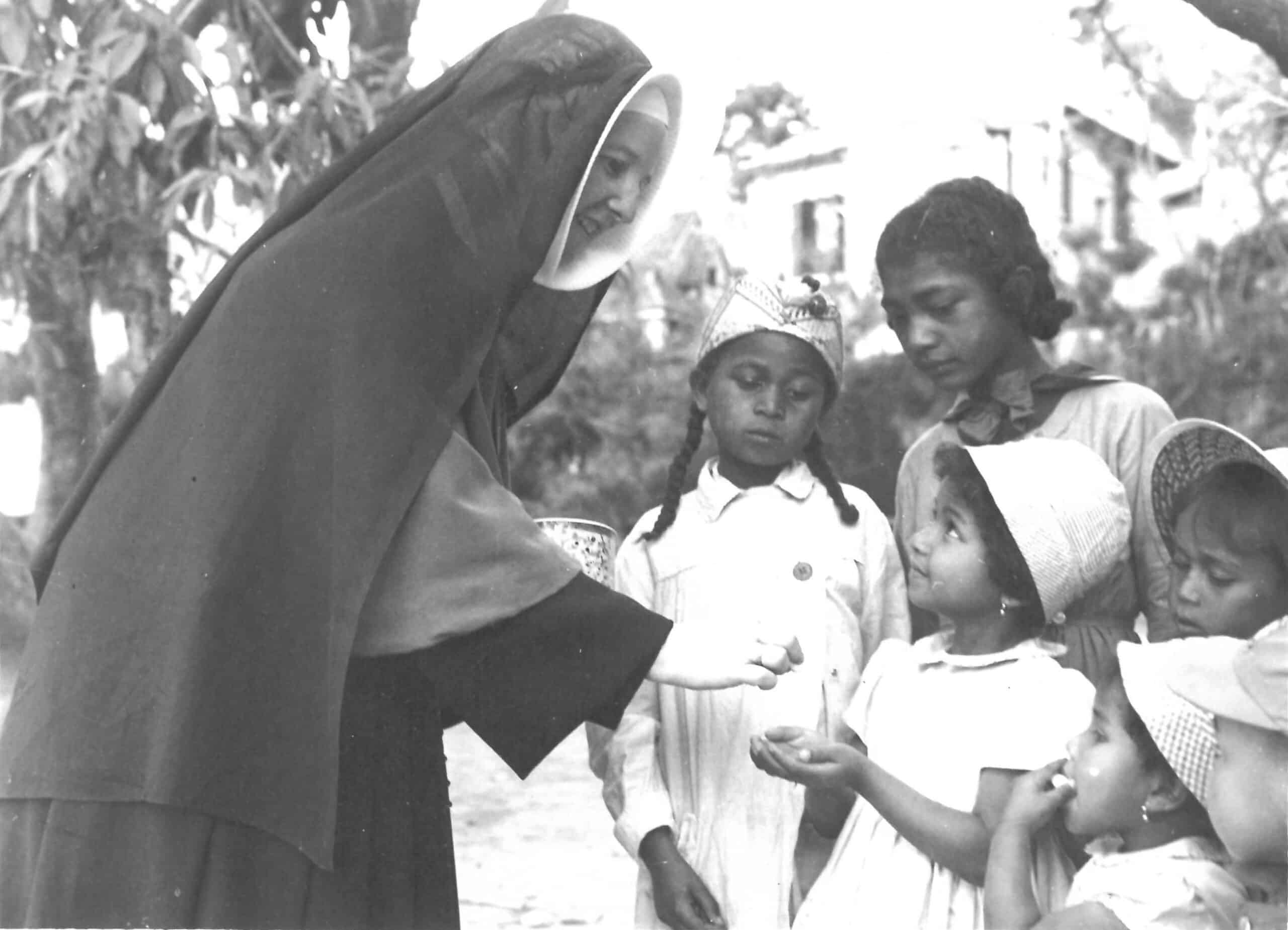
Source: “In Tananarive, a reward for hard work!” (In Madagascar, the Sisters used candy as a motivational tool in their ministry with children.) MM, 3S 3/18c.
“Le Cénacle sous l’Ankaratra” (Newsletter from the Cenacle of the Madagascar Region), Dec. 1956.
In Madagascar, the sisters discovered a different understanding of names and age. They were surprised by this and found themselves awkwardly adapting when the children’s catechism classes began in 1956. This is what the team of catechists described when recounting the events of October 4. After the registration of the children for the French-language catechism classes, it was the turn of the Malagasy-language classes.
Once all these young people have headed home, we prepare to welcome the afternoon students for the MALAGASY LANGUAGE CATECHISM, recruits coming from varying distances…
If the other registrations were difficult at times, what can be said of these? Many of the children can neither read nor write, nor even accurately pronounce their own names! And they come on their own, without their parents! The Mother in charge is assisted by two young Malagasy girls, but even though they are quite resourceful, they find themselves losing… “their Malagasy” in the confusion!
The first question: “Iza no anaran’ny dadanao?” “What is your father’s name?” This is the only way to identify siblings – all children of the same father – since each child’s name is “personal” and tells us nothing about their family ties; for most, a family surname does not yet exist. And the answers are far from clear! The same question three times, three different answers! Our young assistants need a great deal of encouragement to keep up the questioning until they reach some clarity! Then comes the first name: “What is your name?” And out comes a whole assortment of chosen names… one of the best, perhaps: Claude-Ignace de la Colombière. Then it’s time for the Malagasy name: “Ra iza?” I wish you could hear this series of colorful names, full of poetic meaning: “Beautiful Cloud,” “He of a Thousand Riches,” “Child of Goodness,” etc. Finally, the greatest difficulty, at least with the little ones: “How old are you?” Silence… 8 years old?.. Yes… 6 years old? Yes… How to figure it out? We look for an older brother or sister using the father’s name: “How old is he or she?”… A moment of reflection… “Maybe 5 years old,” and until we get a baptismal certificate, that’s all we’ll know!