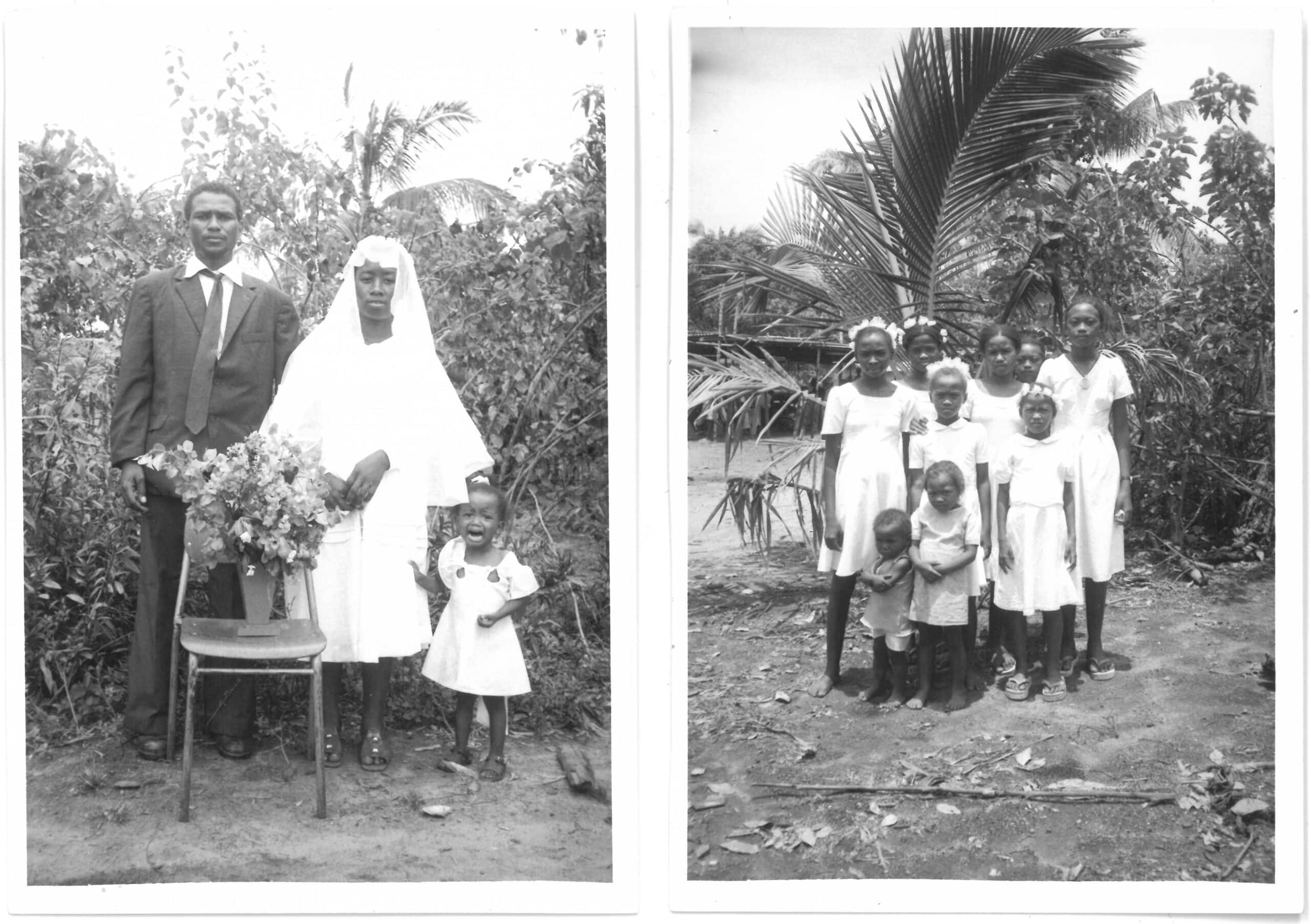
Ambanja, 1981. “A Sakalava household with two children, having only recently received the sacrament of marriage. The first child is in the photo”; “A small group of young Sakalava children on the day of their Confirmation.” Source: MM, 3S 2/18.
In Madagascar, the population is composed of many ethnic groups, each with its own culture and dialect. These groups are generally divided into two main categories: the “Highlanders” and the “Coastal” peoples. In 1982, during a canonical visit, the Sisters noted that their ministry brought them into contact with several different ethnicities: the Merina in the Highlands; the Betsileo, south of Antsirabe and in Fianarantsoa; the Sakalava in the northwest (Ambanja); and the Bara in the southeast (Farafangana).
This diversity directly impacts their missionary work: “since the sisters were all from the Highlands (though of different types), they had to adapt to a mindset that was not their own, and it was necessary for them to learn the local dialect if they wanted their ministry to be fruitful.”
This adaptation is essential because customs vary from one people to another. For example, among the Sakalava (“inhabitants of the long valleys”), couples often begin marriage preparation while they are already living together and have children (such as the couple photographed with one of their children after their church wedding). This requires the Sisters to change their preparation process, as they usually prepare engaged couples before they marry or live together.
The mixing of cultures and social backgrounds also creates human challenges. In 1956, at the bush Cenacle in Ambohipo, the training of future brides encountered obstacles linked to traditions and origins. The Sisters recounted this experience:
“There remained another, more subtle difficulty of a psychological nature: once the group was formed, how were we to merge such diverse elements from different regions and castes into a common effort? […] From the very first year, when forming work teams, we ran into opposition based either on caste: ‘I do not want to be with slaves,’ proudly declared Suzanne, who came from the high Malagasy nobility and was indeed paired with descendants of families formerly subjected to slavery—or on region: the ethnic groups are diverse, as are the traditions and the pace of development (the areas near the city, for example, are more humanly developed but also, alas, marked by a loud and superficial civilization). In 1956, it began with the clash between two of the most developed districts, and in order to achieve the essential efforts toward a fraternal and evangelical understanding, it was necessary to grant some concessions, including making diplomatic rearrangements in the dormitories” (“Le Cénacle sous l’Ankaratra,” News Bulletin of the Cenacle of the Madagascar Region, Dec. 1956).