
Treasures
from the Archives
Our Lady of the Cenacle
Treasures
from the Archives
Our Lady of the Cenacle
My heart is as big as the world
Sainte Thérèse Couderc
The missionary impulse of the Cenacle pushed the Congregation to cross borders early on, with a first foundation outside of France in 1879 in Rome. Yet, well before the Sisters settled abroad, borders had already been crossed by women who joined the Congregation, which at that time was present only in France. As early as the 1850s – less than 30 years after the foundation – women of various origins made the Cenacle their home. Between 1853 and 1879, the postulants who joined were born in no fewer than eight different countries: France, the German duchies, then Switzerland, but also Argentina, Scotland, the United States of America, and Italy.
This initial diversity was prophetic: it anchored internationality not as a simple expansion strategy, but as a lived reality at the very heart of community life. Before being a congregation established throughout the world, the Cenacle was first a community where the world found its place.
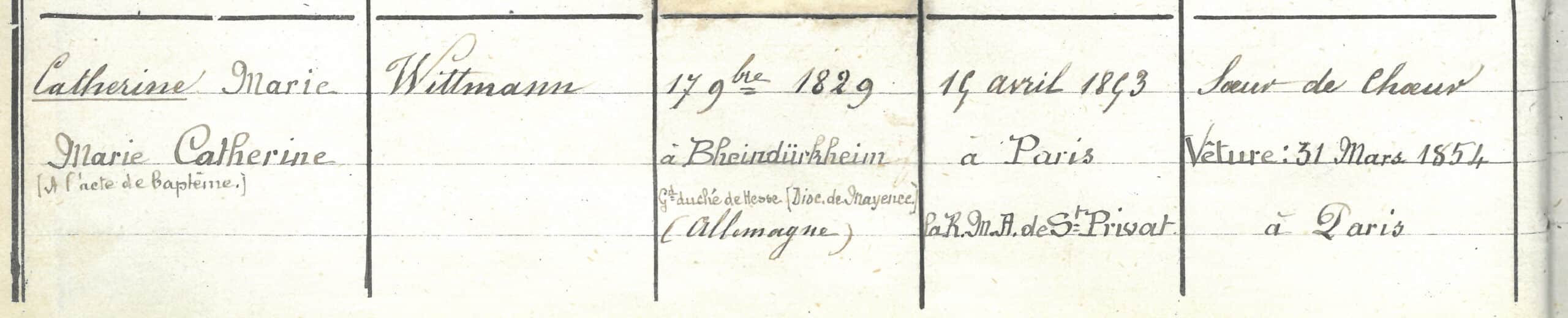
Information in the General Catalog regarding Sr. Catherine Wittmann (detail), the first Sister born outside of France, who entered in 1853.
Source: MM.
With the multiplication of foundations starting at the end of the 19th century, the Congregation became global. In 1919, the division into “Provinces” allowed religious life to become inculturated by adapting to local realities (language, pace of life, food, climate). This adaptation was not immediate, however: at first, there were fears that the charism might be altered by these regional specificities.
The organic development of the Congregation allowed the Sisters to experience the challenges of internationality. Sisters of various cultures cohabited within the same provinces (Belgium-Netherlands, England-Ireland, Europe-Togo, Asia…). However, this proximity required moving beyond linguistic barriers and differences in mindsets within a single Province. History is marked by some friction: in Belgium and the Netherlands, the difficulty for French-speaking Sisters to adapt to the Flemish or Dutch context; in France and Switzerland in the 1980s, the Swiss-German Sisters challenged the Province so that their language and culture would be taken into account.
The government of the Congregation also became internationalized. In Paris and then in Rome, the Sisters serving at the general level were of various nationalities and mother tongues. Until the mid-20th century, however, it was too early to speak of interculturality in its functioning and community life. French remained the language of exchange and work for a long time. Nevertheless, as early as 1938, the General Council became internationalized with Mothers Ellen Mallon, American, and Eugenia Maranzana, Italian, as General Assistants.
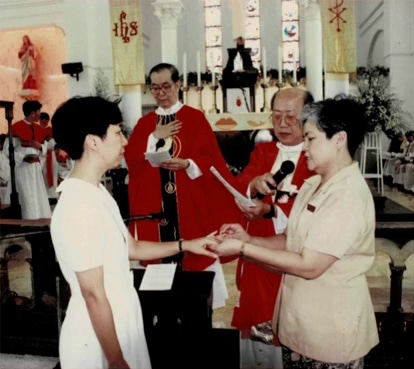
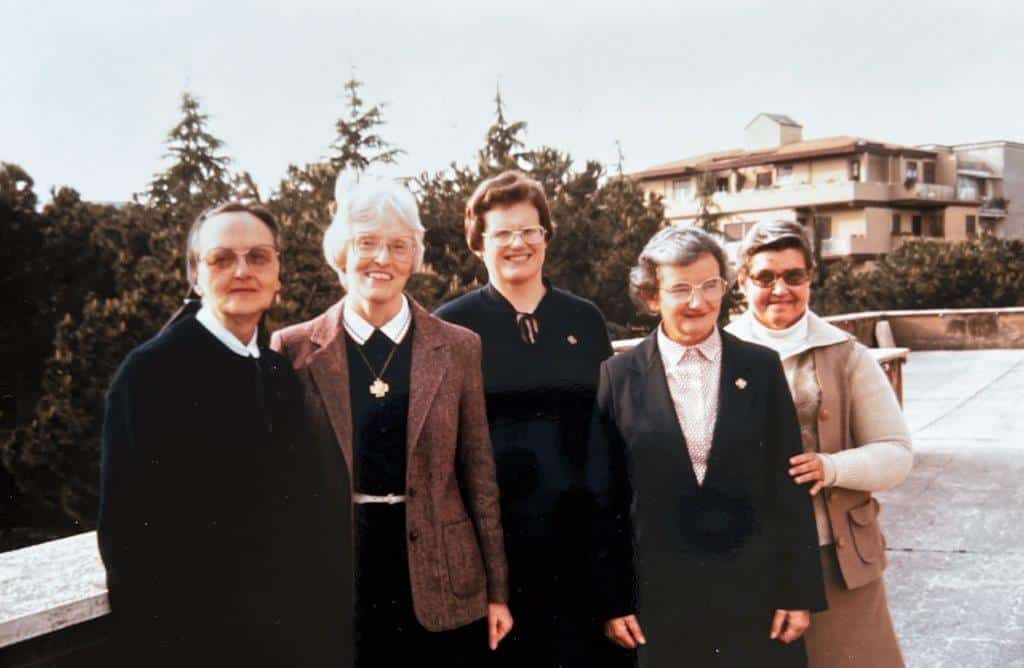
In May 1986, on the rooftop of the Generalate in Rome, the General Council was completely international: Superior General Sr. Barbara Ehrler (American), and the General Councilors: Sisters Elisabeth Prache (French), Jean Page (English), Kathleen Ryan (from New Zealand), and Maria das Dores Pimenta (Brazilian). Source: Sr K. Ryan.
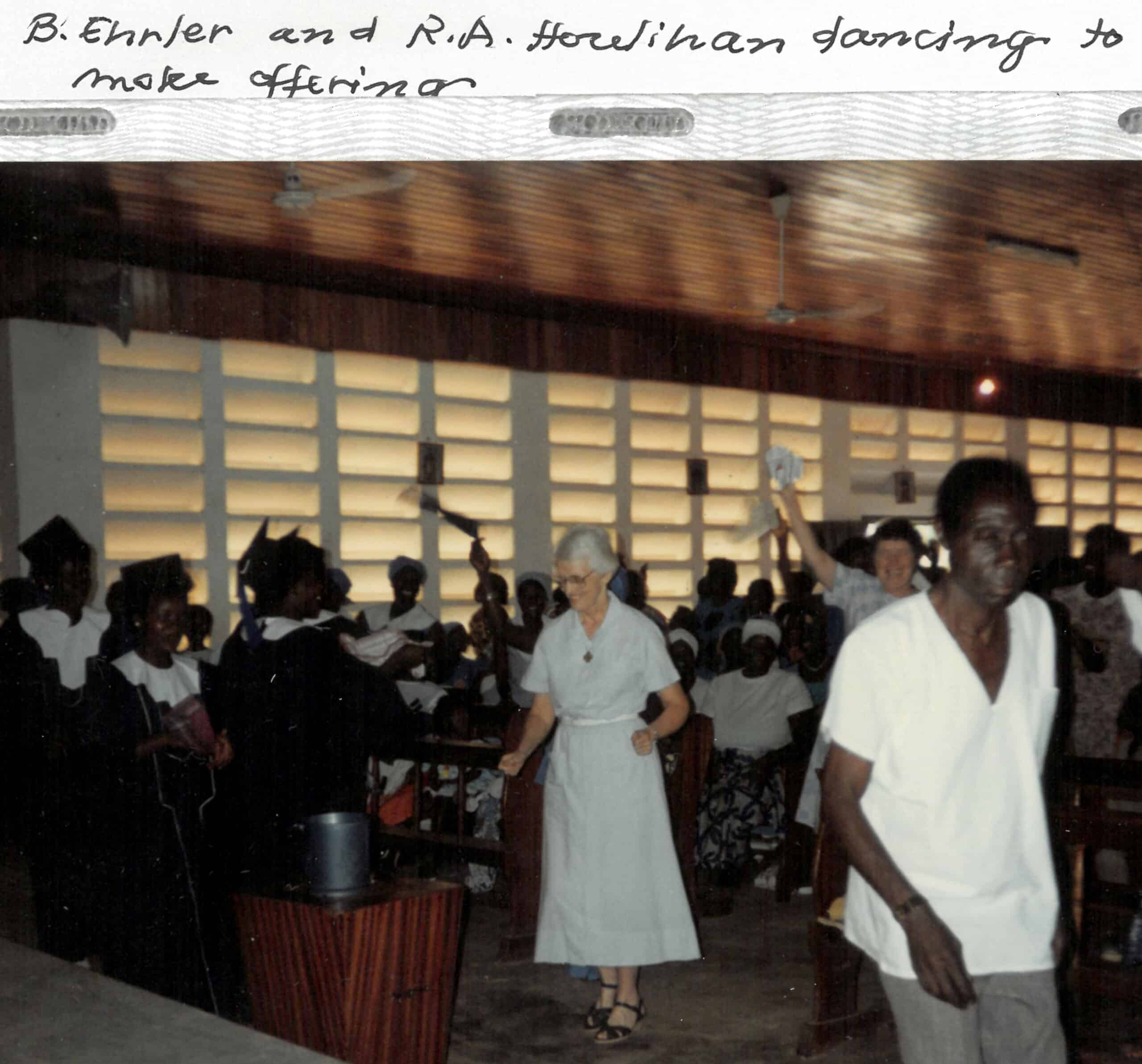
The canonical visits of the Superior General are privileged moments of intercultural encounter, such as in Ghana in 1990, where Sr. Barbara Ehrler participated in inculturated rites (danced procession).
The question of internationality emerged as a subject of reflection at the Enlarged General Council (EGC) of 1985. The 1986 General Chapter (which introduced the Preferential Option for the Poor) affirmed its value and encouraged international meetings and the exchange of personnel between Provinces.
In April 1988 in Lantana (USA), along with Father Marcello Azevedo SJ, the Congregation defined inculturation as the “process of evangelization according to which […] faith develops in the terms and according to the particular genius of the culture that receives it;” culture being seen not only as national, but also as regional, generational, social…
The Sisters also heard the call to establish an international, interprovincial apostolic community (a call that was renewed in 2008 and 2010).
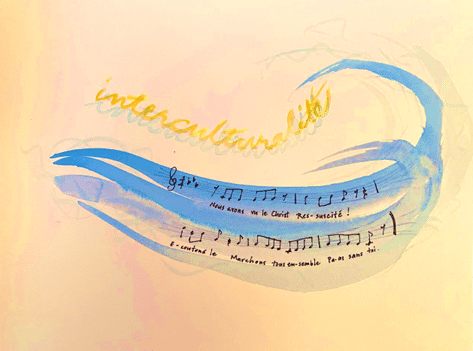
Subsequent Chapters marked a profound evolution:
One of the goals of international meetings is also to strengthen the Congregation’s intercultural Body through better mutual understanding. Beyond sharing in assemblies, moments of recreation and celebration are opportunities for fraternal and cultural sharing.
Thus, participants at the meeting of the international network for Justice, Peace, and the Integrity of Creation (JPIC) in Manila (Philippines) in 2007 tried their hand at Tinikling, a traditional local dance (See the picture of the menu, source: NAP). The dancer must jump in and out of bamboo poles as they are clashed together, without getting their feet caught.
To strengthen the international sentiment among the Sisters, recent meetings and Chapters have emphasized language learning (French and/or English) and recommended the continuation of the international Tertianship and the resumption of the international Renewal, as opportunities to temporarily experience community in an intercultural way.
The evolution of the Congregation is gradually bringing together Sisters from different countries in intercultural communities, with all the enrichment, joys, and challenges that this entails in daily life.
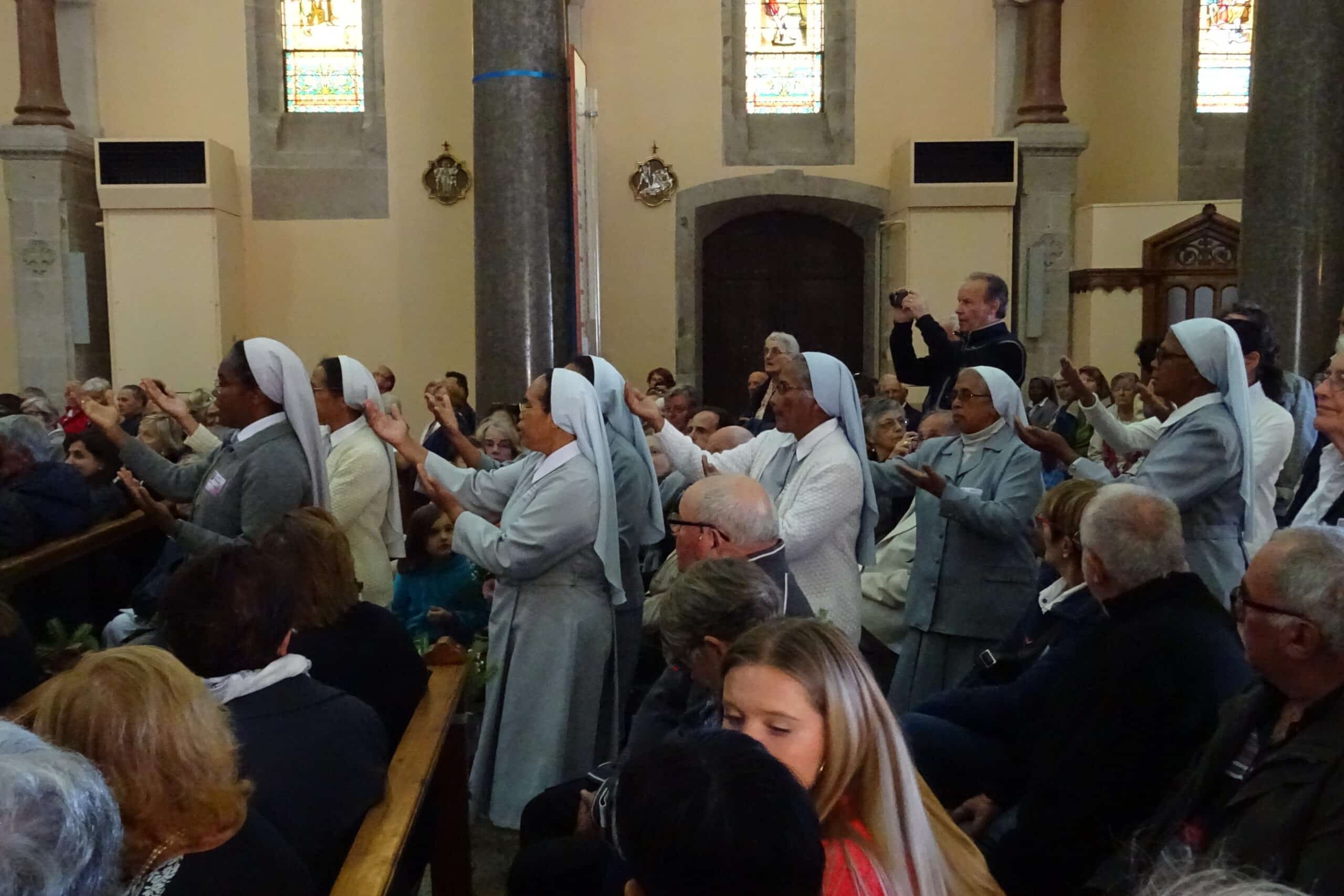
Offertory procession danced by Malagasy sisters during the Mass following the transfer of Mother Thérèse’s body from the sisters’ chapel to the basilica of Lalouvesc, in 2018.